
Employee Engagement & Retention · THOUGHT LEADERSHIP
Why Are Good Employees Leaving GCC Companies Despite Competitive Salaries?
Competitive salaries may attract talent, but they do not always

Ravindra Cunniah Venkata
Founder & Director, Sanira Consultants WLL
November 2026 · 6-minute read
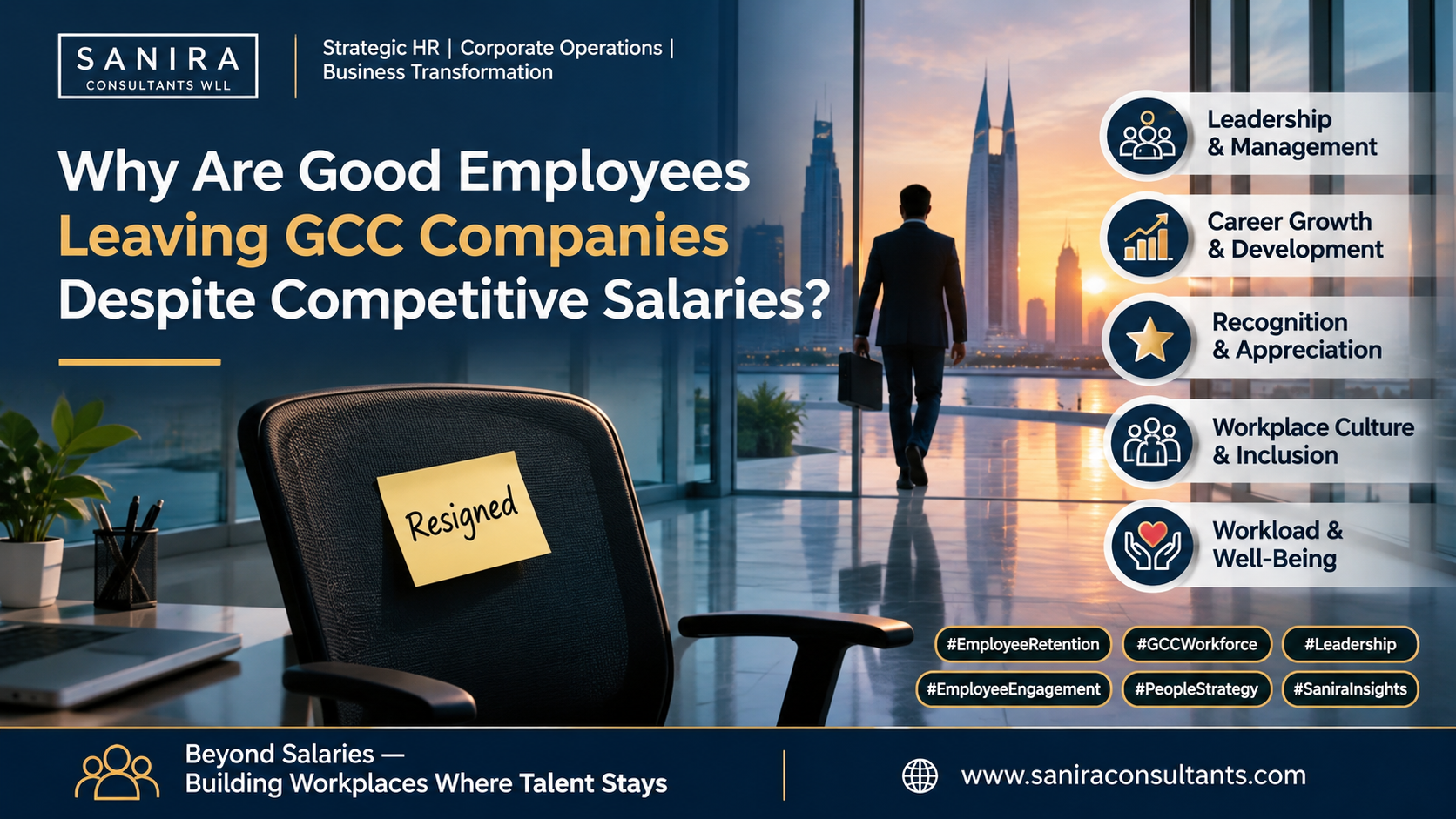
Why Are Good Employees Leaving GCC Companies Despite Competitive Salaries?
By Ravindra Cunniah Venkata | Founder & Director, Sanira Consultants WLL
Companies keep reviewing salaries. Employees keep resigning. Are we solving the wrong problem?
Across the Gulf Cooperation Council (GCC), organizations continue to invest in competitive compensation packages, employee benefits and recruitment initiatives to attract and retain skilled professionals.
Yet an important question remains: Why do capable, experienced and high-performing employees continue to leave organizations that offer attractive salaries?
The answer often extends far beyond compensation.
While remuneration is an important consideration in employment decisions, long-term employee commitment is also influenced by leadership quality, professional growth, organizational culture, recognition and the overall employee experience.
For GCC businesses competing for specialized talent, understanding these factors is becoming increasingly important.
1. Competitive Salaries Attract Talent. Leadership Encourages Them to Stay.
One of the most overlooked factors in employee retention is the quality of day-to-day leadership.
Employees may join an organization because of its reputation, compensation package or career opportunities. However, their relationship with their immediate manager often shapes their experience of the organization.
Poor communication, excessive micromanagement, inconsistent decisions and a lack of trust can gradually erode employee commitment.
Conversely, leaders who communicate clearly, empower their teams, provide constructive feedback and demonstrate fairness can create an environment where employees feel respected and motivated.
The leadership question: Are managers being evaluated only on operational performance, or also on their ability to develop, engage and retain people?
Organizations should consider incorporating people-management indicators into leadership performance assessments.
2. Career Stagnation Can Become More Expensive Than Salary Dissatisfaction
Many professionals, particularly ambitious and high-performing employees, want more than financial security.
They seek opportunities to develop new competencies, assume greater responsibilities and progress professionally.
When employees perceive limited career advancement, unclear promotion criteria or insufficient investment in their development, they may begin exploring opportunities elsewhere.
This challenge can be particularly relevant to GCC organizations where specialized expertise, international talent mobility and evolving business requirements influence workforce expectations.
Organizations can respond by establishing structured career development frameworks, internal mobility opportunities, succession plans and transparent promotion criteria.
An employee who cannot visualize a future within an organization may eventually begin searching for that future elsewhere.
3. Recognition Is Not Always Financial
Organizations sometimes assume that attractive compensation automatically communicates appreciation.
However, recognition extends beyond annual increments, bonuses and financial incentives.
Employees also value acknowledgment of their contributions, opportunities to participate in important decisions and appreciation from senior leadership.
A workplace where exceptional performance receives little acknowledgment may unintentionally discourage employees from going beyond their minimum responsibilities.
Recognition should therefore become part of everyday leadership practices rather than an occasional activity.
Effective recognition is timely, meaningful, fair and connected to organizational values.
4. Workplace Culture Can Undermine Even the Best Compensation Strategy
Organizational culture is not defined merely by corporate values displayed on a website or in an employee handbook.
It is reflected in how decisions are made, how disagreements are handled, how managers treat employees and whether policies are applied consistently.
Employees are more likely to develop lasting organizational commitment when they experience transparency, fairness, inclusion and psychological safety.
Conversely, workplace politics, inconsistent management practices, favoritism and unresolved grievances can weaken employee trust.
For organizations operating across different GCC markets and managing multicultural workforces, cultural awareness and consistent people-management practices deserve particular attention.
A healthy organizational culture must be demonstrated through leadership behavior, not simply communicated through corporate statements.
5. Workload, Well-Being and the Employee Experience Matter
Competitive compensation does not necessarily compensate for continuously excessive workloads, unclear responsibilities or inadequate organizational support.
Employees increasingly evaluate employment opportunities in terms of their overall professional and personal experience.
This includes reasonable workload expectations, effective communication, workplace flexibility where operationally feasible, and access to supportive management.
Organizations should regularly examine whether workforce planning, staffing levels and operational processes enable employees to perform effectively without unnecessary pressure.
Employee well-being should not be treated solely as an HR initiative. It is also an organizational effectiveness and business sustainability consideration.
6. Exit Interviews Alone Are Not Enough
Many organizations attempt to understand employee dissatisfaction only after a resignation has been submitted.
By that stage, opportunities for meaningful intervention may already be limited.
A more proactive approach involves regular employee engagement assessments, structured manager conversations, confidential feedback channels and periodic stay interviews.
A stay interview explores what motivates an employee to remain, what challenges they experience and what changes might strengthen their commitment.
Organizations should also examine workforce data to identify patterns.
For example:
- Are resignations concentrated within particular departments?
- Are high-performing employees leaving at specific career stages?
- Do certain managers experience consistently higher employee turnover?
- Are employees departing shortly after performance reviews or promotion decisions?
- Is voluntary turnover associated with limited development opportunities?
These questions can help leadership teams move from reactive employee replacement toward evidence-informed retention strategies.
7. Employee Retention Is a Business Strategy, Not Merely an HR Responsibility
The financial implications of employee turnover extend beyond recruitment expenditure.
Organizations may experience productivity disruptions, knowledge loss, additional training requirements, increased pressure on remaining employees and interruptions to customer relationships.
The consequences can be particularly significant when experienced technical specialists, operational leaders or employees possessing critical institutional knowledge leave.
Employee retention should therefore be integrated into strategic workforce planning, leadership development, performance management and organizational effectiveness initiatives.
HR functions play an important role in designing these frameworks, but their success depends on active participation from business leaders and line managers.
Retention cannot be delegated entirely to HR when the employee experience is shaped throughout the organization.
8. What Should GCC Organizations Do Differently?
Organizations seeking to strengthen employee retention should consider a structured approach built around five priorities.
First: Strengthen leadership accountability. Evaluate managers not only on business results but also on team development, employee engagement and retention outcomes.
Second: Create visible career pathways. Establish transparent competency frameworks, internal progression opportunities and succession planning mechanisms.
Third: Build a culture of recognition and fairness. Encourage consistent appreciation, transparent decisions and equitable application of organizational policies.
Fourth: Listen before employees resign. Use engagement surveys, stay interviews and workforce analytics to identify concerns early.
Fifth: Align people strategy with business strategy. Ensure workforce planning, performance management, compensation, organizational design and leadership development work together rather than functioning as disconnected HR activities.
These measures should be tailored to each organization's operating environment, workforce composition and business priorities.
The Strategic Question for GCC Business Leaders
Competitive compensation remains important. Organizations must continue to ensure that remuneration is appropriate, fair and aligned with market conditions.
However, increasing salaries alone may not resolve underlying problems associated with ineffective leadership, limited career opportunities or an unhealthy workplace culture.
The more valuable question may not be:
“Are we paying our employees enough?”
It may be:
“Are we creating an organization where talented employees genuinely want to build their careers?”
Organizations that address this question systematically may be better positioned to retain critical talent, strengthen workforce capability and support sustainable business performance.
How Sanira Consultants WLL Can Help
At Sanira Consultants WLL, we believe that effective employee retention begins with understanding the relationship between people, leadership, organizational structures and business performance.
We support organizations across the GCC through strategic HR advisory services, organizational development, employee engagement initiatives, performance management frameworks, workforce planning and leadership effectiveness.
Our approach focuses on identifying underlying organizational challenges and developing practical, sustainable people-management solutions aligned with business objectives.
Because retaining valuable employees requires more than competitive salaries. It requires an organization worth staying with.
Sanira Consultants WLL Strategic HR | Corporate Operations | Business Transformation
Empowering Organizations Across the GCC
Website: www.saniraconsultants.com
For strategic HR and organizational effectiveness enquiries, connect with Sanira Consultants WLL.
Turn your people strategy into business value.
Sanira Consultants WLL supports GCC organizations with strategic HR advisory, workforce planning, organizational design, shared services and operational improvement.
Book a consultation ↗ Business assessment ↗